Fuel Pump Failure Safety Calculator
Enter Your Symptoms
Driving Conditions
Enter your symptoms and driving conditions to see if it's safe to drive.
You hear a strange whining noise from the back of your car. The engine sputters when you accelerate. Then, one morning, it won’t start at all. You check the fuel gauge - it’s half full. So what’s wrong? It could be your fuel pump. And now you’re wondering: can I drive with a bad fuel pump? The short answer? Maybe - but you shouldn’t.
What a fuel pump actually does
Your fuel pump isn’t just a little motor tucked under the tank. It’s the heart of your fuel system. It pulls petrol from the tank, pushes it through the lines, and delivers it to the engine at the right pressure - usually between 30 and 60 psi, depending on your car. Modern cars use electric fuel pumps inside the tank, cooled by the fuel around them. That’s why running low on fuel is bad - the pump overheats without enough liquid to keep it cool.
If the pump starts to fail, it doesn’t just stop working overnight. It fades. Like a battery losing charge. At first, you might notice hesitation when you press the gas. Then, the engine might stall at traffic lights. Later, it won’t restart after you turn it off. These aren’t random glitches - they’re signs the pump can’t keep up.
Signs your fuel pump is failing
- Engine sputtering at high speeds - especially on the motorway
- Loss of power when accelerating or climbing hills
- Car won’t start, even though the battery is fine
- Loud whining or humming noise from the rear of the car
- Fuel economy drops suddenly - no other changes to driving habits
- Engine misfires or stalls, then starts again after sitting for a few minutes
These symptoms often get mistaken for spark plug issues, clogged injectors, or even a bad sensor. But if you’ve ruled out those, and the car struggles to maintain consistent fuel flow, the pump is the likely culprit. In the UK, where many drivers rely on older diesel models or high-mileage petrol cars, fuel pump failure is one of the top five causes of roadside breakdowns in winter months.
Can you drive with a bad fuel pump?
Technically, yes - if the pump hasn’t completely failed yet. You might be able to drive a few miles to the nearest garage. But here’s the problem: it’s unpredictable.
Imagine driving on the M60 near Manchester at 70 mph. The pump is struggling. One moment, you’ve got power. The next, the engine cuts out. No warning. No coasting. Just silence. You’re in the fast lane with trucks behind you. That’s not a risk worth taking.
Even if you’re only going to the supermarket, a failing pump can leave you stranded. And if you’re on a narrow country road with no phone signal, you’re not just inconvenienced - you’re unsafe.
There’s also damage you can’t see. When the pump runs weak, it pushes less fuel than the engine needs. That creates a lean air-fuel mixture. Over time, that can burn valves, damage the catalytic converter, or even cause engine knock. Repairing those issues costs five times more than replacing the pump.
What happens if you keep driving?
Driving with a bad fuel pump is like running a marathon with a leaking water bottle. You might finish - but you’ll collapse before the end.
Here’s what typically happens if you ignore the warning signs:
- Stage 1: Intermittent performance - The car runs fine for a while, then stumbles. You blame the fuel quality or bad petrol station.
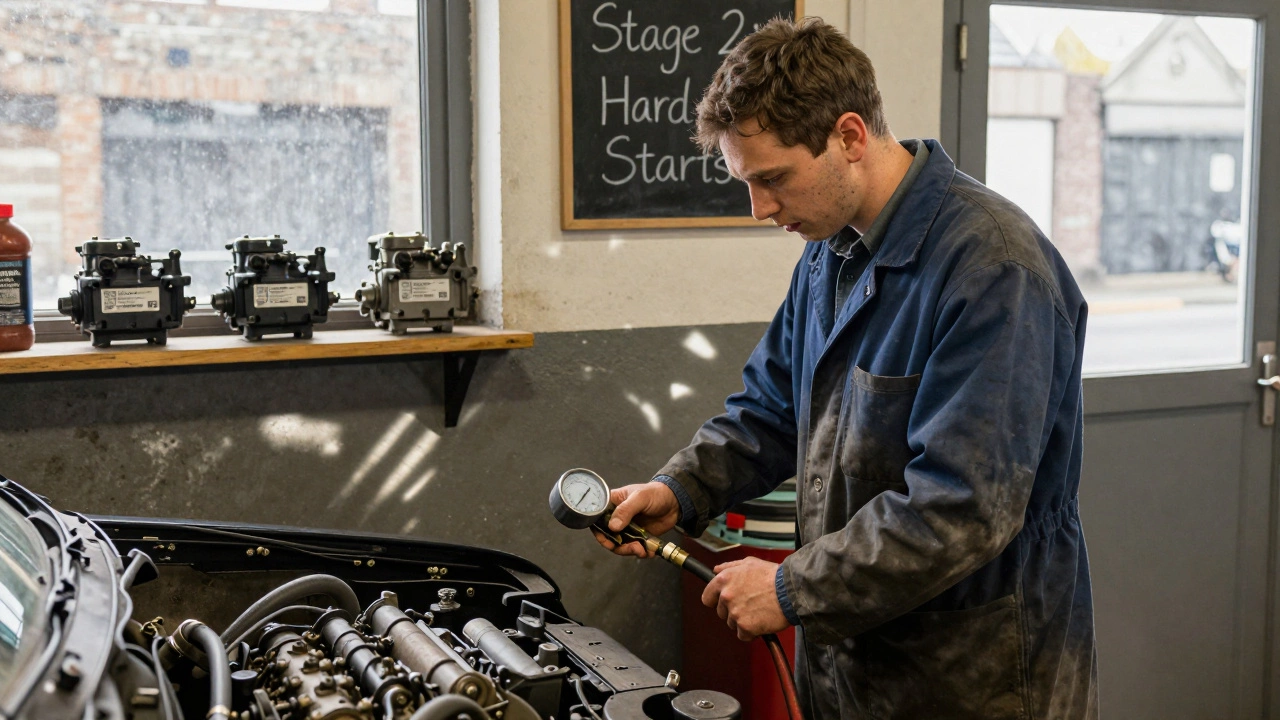
- Stage 2: Hard starts - You turn the key and wait. The engine cranks but won’t fire. After a few tries, it starts. That’s the pump struggling to build pressure.
- Stage 3: Complete failure - The car won’t start at all. No noise from the tank when you turn the key. No fuel reaching the injectors.
At Stage 2, you’re already in danger. The pump is worn out. Every time you start the car, you’re stressing it further. The motor’s brushes are wearing down. The impeller is cracking. Once it dies, you’re not just out of luck - you’re looking at a tow bill, a new pump, and possibly engine damage.
How long can you drive before it dies?
There’s no fixed timeline. Some pumps last 100 miles after they start failing. Others hold on for 500. It depends on the car, the fuel quality, and how hard you’re driving it.
One mechanic in Salford told me about a customer who drove a 2010 Ford Focus for three weeks with a failing pump - commuting 40 miles each way. He kept restarting it after it stalled. By the end, the pump was so weak, it fried the relay. The car needed a new pump, a new relay, and a cleaned fuel line. Total cost: £850. Replacing the pump at the first sign of trouble would’ve cost £320.
That’s the real cost of waiting.
What should you do if you suspect a bad fuel pump?
Don’t guess. Don’t wait. Do this:
- Listen for the pump when you turn the key to “on” (before starting). You should hear a quiet hum for two seconds. If you hear nothing, the pump isn’t getting power - or it’s dead.
- Check the fuel pressure with a gauge. Most garages can do this in 15 minutes. If pressure is below the manufacturer’s spec (look it up online), the pump is failing.
- Test the relay. A bad relay can mimic pump failure. Swap it with another relay in the fuse box (like the horn relay) and try starting the car.
- If the pump is confirmed bad, get it replaced. Don’t delay.
Don’t try to “fix” it with fuel additives. They don’t help worn-out motors. Don’t refill with premium fuel hoping it’ll save you - it won’t. This isn’t a clogged filter. This is mechanical failure.
Replacement costs and options
In the UK, replacing a fuel pump typically costs between £300 and £700, depending on the car. Luxury models like BMWs or Audis can go over £900. Labour takes 2-4 hours because the tank often has to be dropped.
Here’s what you’re paying for:
| Component | Cost Range |
|---|---|
| Fuel pump (OEM) | £150-£400 |
| Fuel pump (aftermarket) | £80-£200 |
| Labor (2-4 hours) | £120-£300 |
| Fuel filter replacement (recommended) | £30-£60 |
| Tank cleaning (if contaminated) | £50-£100 |
Always replace the fuel filter at the same time. It’s cheap, and if the pump failed, debris likely clogged the filter too. Skipping this step means your new pump will fail sooner.
How to prevent fuel pump failure
You can’t stop wear forever - but you can delay it:
- Never let your tank drop below a quarter full. Fuel cools the pump. Running low = overheating.
- Use quality fuel. Cheap petrol often has more water and contaminants that clog filters and corrode pump parts.
- Replace the fuel filter every 40,000 miles - even if the manual says 60,000. It’s cheap insurance.
- Avoid filling up at stations with visibly dirty pumps or long queues - sediment settles at the bottom.
These habits won’t make your pump last forever. But they’ll give you another 50,000 miles - and maybe save you from being stranded on the A34.
Final advice: Don’t gamble with your safety
Driving with a bad fuel pump is like driving with worn brakes. You might make it home. But when you need to stop - really stop - it won’t work.
If your car is sputtering, stalling, or struggling to start, get it checked. Today. Not tomorrow. Not next week. The cost of a tow truck, a rental car, or a damaged engine far outweighs the price of a new pump. And the risk to your safety isn’t worth the gamble.
Your car isn’t just a machine. It’s your way to work, to school, to family. Don’t let a £300 part turn into a £1,500 problem - or worse, a dangerous situation on a dark, wet road.
Can a bad fuel pump cause the engine to stall while driving?
Yes. A failing fuel pump can’t deliver consistent fuel pressure, especially under load like accelerating or climbing hills. This causes the engine to misfire or cut out completely. It often happens suddenly, without warning, and may restart after cooling down - but it’s a sign the pump is near failure.
How do I know if it’s the fuel pump or something else?
Start by listening for the fuel pump’s hum when you turn the key to “on.” No sound means no power or a dead pump. Check the fuse and relay first - they’re cheap fixes. If those are fine, a fuel pressure test at a garage confirms if the pump is delivering enough pressure. Other issues like clogged injectors or bad spark plugs usually cause different symptoms, like rough idle or misfires on startup.
Can I drive my car if the fuel pump is making noise?
A loud whining or grinding noise from the rear of the car is a classic sign of a worn fuel pump. You might be able to drive short distances, but the noise means the internal parts are grinding down. Continuing to drive risks complete failure and possible engine damage. Replace it as soon as possible.
Will a bad fuel pump trigger a check engine light?
Sometimes. If the engine runs too lean due to low fuel pressure, the ECU may set codes like P0171 (system too lean) or P0087 (fuel rail pressure too low). But not all failing pumps trigger a light - especially early on. Don’t wait for the light to come on. If you’re experiencing symptoms, get it checked.
Is it safe to drive with a bad fuel pump to the nearest garage?
Only if you’re very close - under a mile - and you drive slowly, avoiding hills and heavy traffic. Even then, there’s a risk the pump dies while you’re on the road. If you’re more than a few minutes away, call a breakdown service. It’s cheaper and safer than risking a stall on a busy road.