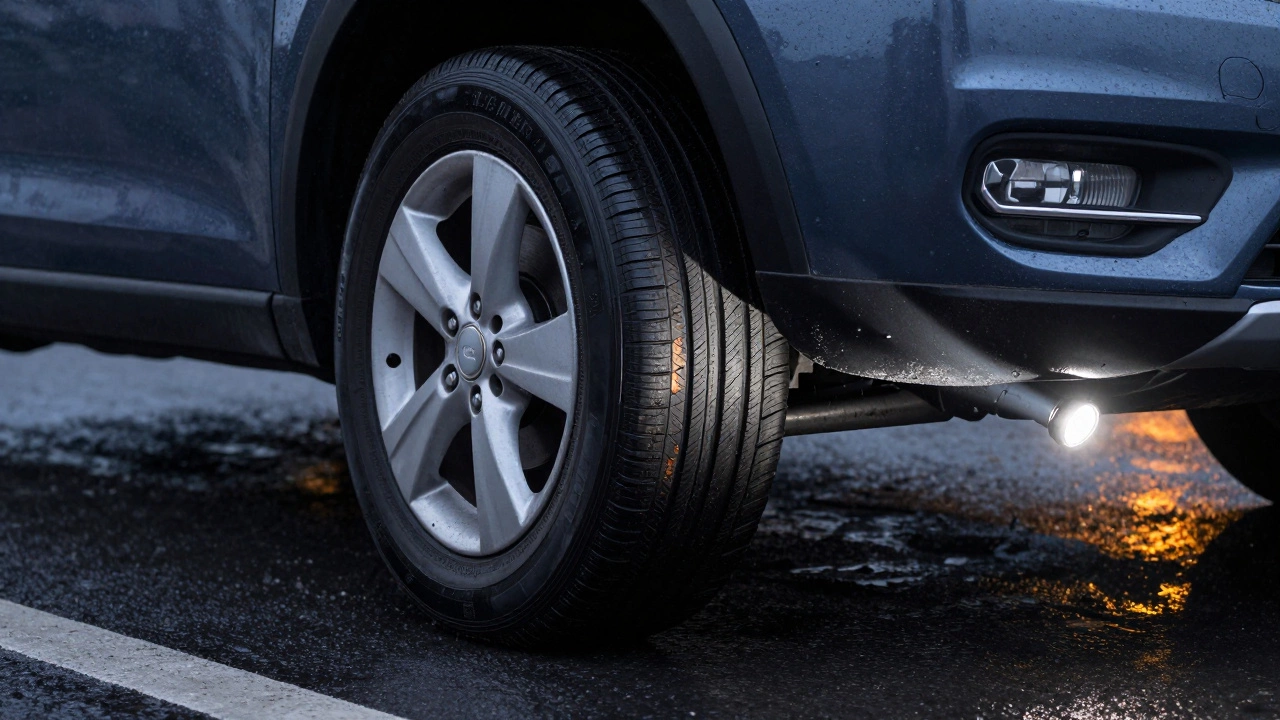
If your car feels off-like it’s pulling to one side, bouncing too much, or making strange noises over bumps-it’s not just the tires. It could be something deeper: a bent suspension component. And if you ignore it, you’re not just risking comfort-you’re risking safety. Suspension parts don’t just wear out over time. They can snap, crack, or bend from a single bad hit: a pothole, a curb, or a minor accident you thought was no big deal.
Most people check their tires or brakes when something feels wrong. But suspension damage doesn’t always show up on a visual inspection. You need to know what to look for. And more importantly, how to test it. Here’s how to tell if your suspension is bent-without a mechanic’s diagnostic tool.
Look for Uneven Tire Wear
One of the first signs of a bent suspension is uneven tire wear. If one side of your front tires is bald while the other side still has tread, that’s not normal. Same with the rear. If you see cupping-small dips or scalloped edges on the tire surface-that’s a classic red flag.
This happens because a bent control arm, strut, or steering component throws off the wheel’s alignment. The tire doesn’t sit flat on the road anymore. Instead, it’s tilted inward or outward, or the toe angle is off. That forces part of the tread to drag or scrape against the pavement every time you drive.
Check your tires every month. Run your hand across the tread. If you feel ridges or bumps instead of smooth rubber, your suspension geometry is likely out of whack. And no, rotating the tires won’t fix it. That just moves the problem around.
Notice Pulling or Drifting
When you let go of the steering wheel on a straight, flat road, does your car drift to the left or right? If yes, and you’ve already ruled out low tire pressure or mismatched tires, the suspension is probably bent.
A bent lower control arm or a twisted subframe can create unequal angles on each side. The wheels point in slightly different directions, so the car pulls. It’s not steering wheel play. It’s the entire front end being misaligned because a metal part got bent under stress.
Try this: drive on a quiet, level road. Keep your hands off the wheel for a few seconds. If the car pulls hard enough that you have to constantly correct it, that’s not a wheel alignment issue. That’s structural damage. A simple alignment will fix the symptoms-but not the cause. The bend is still there.
Listen for Clunking or Rattling Noises
Bent suspension parts don’t always make noise right away. But when they do, it’s unmistakable. A loud clunk when you hit a bump? A rattle that gets worse when you go over rough pavement? That’s metal hitting metal because something’s loose, cracked, or out of position.
Common culprits:
- Bent control arm with a cracked bushing
- Strut tower that’s warped or torn from impact
- Broken sway bar link or loose mounting bolt
- Cracked or misaligned steering knuckle
These aren’t just annoying sounds. They mean parts are moving when they shouldn’t. That puts extra stress on other components-ball joints, tie rods, even your brakes. Over time, it leads to complete failure.
Do a quick test: bounce each corner of the car hard three times. Listen closely. If one side sounds hollow or clunky compared to the others, that’s a sign something’s damaged. A healthy suspension springs back smoothly. A bent one makes noise.
Check Ride Height
One of the easiest ways to spot suspension damage is to look at your car from the side. Is one corner lower than the others? Even by an inch? That’s not normal.
Modern cars have a very precise ride height. A bent spring, a collapsed strut, or a warped control arm can drop one side of the car. You might not notice it until you park next to another identical car. Or until you see the tire is too close to the fender liner.
Measure it. Use a tape measure from the center of the wheel hub to the bottom edge of the fender. Do this on all four corners. Write down the numbers. Compare them. If any side is more than 0.5 inches different from the others, something’s bent or broken.
Don’t confuse this with sagging springs from age. Those usually affect both sides equally. A bent part affects one side only.
Perform the Bounce Test
This is a simple trick used by mechanics. Push down hard on one corner of the car-like you’re trying to sit on it-and let go. Count how many times it bounces before settling.
Good suspension: one or two bounces, then stops.
Bad suspension: three or more bounces, or a slow, wobbly motion.
But here’s the key: if one corner bounces differently than the others, that’s a red flag. A bent shock absorber mount, a damaged spring seat, or a warped strut housing can change how the suspension reacts. You’re not just losing damping-you’re losing control.
Inspect the Components Visually
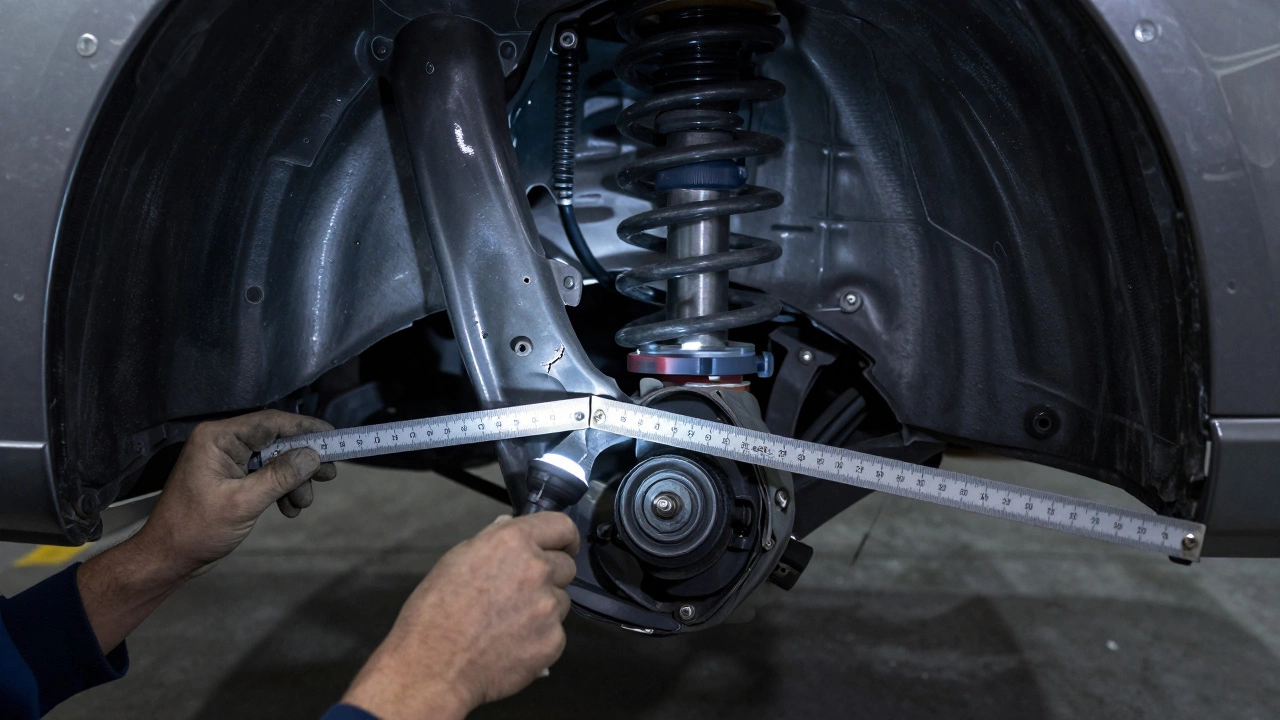
Jack up the car and get under it. Use a flashlight. Look for:
- Cracks in control arms or sway bars
- Twisted or bent metal
- Fluid leaks from the strut or shock
- Loose or missing bolts
- Worn or split rubber bushings
A bent control arm might not look obviously bent to the naked eye. But if you lay a straight edge-like a long metal ruler-across it, you’ll see gaps where the metal curves unnaturally. A healthy arm is straight from end to end. A bent one looks like it was stepped on.
Also check the steering knuckle. If it’s cracked or twisted, the wheel won’t turn true. That’s dangerous. Even a small bend here can make steering unpredictable at highway speeds.

Get a Professional Alignment Check
Even if you don’t see obvious damage, get a four-wheel alignment done. A good shop will give you a printout showing the camber, caster, and toe angles on each wheel.
If the numbers are way outside the manufacturer’s specs-especially if one side is fine and the other is off by 2 degrees or more-that’s proof something’s bent. Alignment shops in Manchester use laser systems that measure to the tenth of a degree. They’ll tell you exactly where the problem is.
Don’t just get an alignment and walk away. Ask them to point out which components are out of spec. If they say, “Your left front camber is -3.2 degrees,” and the factory spec is -0.8 to -1.5, that’s not a worn bushing. That’s a bent part.
What Happens If You Ignore It?
Driving with a bent suspension isn’t just uncomfortable. It’s dangerous.
- Braking distance increases because the tires don’t grip evenly
- Steering becomes unpredictable, especially in wet conditions
- Tires wear out in weeks instead of years
- Other parts like ball joints and tie rods fail faster
- You risk losing control on a sharp turn or emergency swerve
One real-world example: a 2021 Ford Focus in Manchester came in after hitting a deep pothole. The driver thought it was just a “weird vibration.” Three weeks later, the left control arm snapped while turning onto a highway. The car veered into a guardrail. No injuries-but the car was totaled. The damage started with a slight bend. No one checked.
Fixing a bent suspension early saves money. Replacing a control arm costs £150-£300. Replacing a whole subframe? £1,200+. And if you damage the steering or brakes? It gets worse.
What to Do Next
If you suspect your suspension is bent:
- Stop driving it as much as possible
- Check tire wear and ride height
- Do the bounce test on all four corners
- Get a professional alignment report
- Have a mechanic inspect the control arms, struts, and steering components
Don’t try to bend it back. Suspension parts aren’t like a bent rim. You can’t hammer them straight. Once metal is deformed under stress, it’s weakened. Replacing it is the only safe option.
And remember: suspension damage doesn’t always come from big accidents. A single pothole at 40 mph can do it. If your car’s been through a rough winter-or even a few bad roads-you owe it to yourself to check.
Can a bent suspension cause my car to pull to one side?
Yes. A bent control arm, strut, or steering component changes the wheel alignment angles, causing the car to drift left or right even when the steering wheel is straight. This isn’t a simple alignment issue-it’s structural damage that needs part replacement.
Will an alignment fix a bent suspension?
No. An alignment adjusts the angles of components that are still in good condition. If a part is bent, the alignment machine will show extreme values that can’t be corrected. The bent part must be replaced first, then the alignment can be done properly.
How much does it cost to fix a bent suspension?
It depends on the part. A control arm replacement costs £150-£300 including labor. A bent strut or shock absorber assembly runs £250-£500. If the subframe is damaged, expect £800-£1,500. The sooner you fix it, the less damage spreads to other parts like tires, ball joints, or steering components.
Can I drive with a bent suspension?
You can, but you shouldn’t. It affects handling, increases stopping distance, and causes uneven tire wear. Worst case, a bent part can fail completely while driving, leading to loss of control. If you must drive, keep speed low, avoid rough roads, and get it checked within a few days.
What causes suspension to bend?
Most commonly, it’s from hitting potholes, curbs, or speed bumps at high speed. Minor accidents-even those you thought were no big deal-can also bend parts. Older suspension components are more brittle and prone to damage. Heavy loads or towing can increase the risk too.