Tire Replacement Advisor
Our Recommendation:
Fill in your vehicle details to see if you need 2 or 4 new tires.
- All-Wheel Drive (AWD) cars: Usually require all 4 tires to be replaced to avoid damaging the differential.
- Front-Wheel Drive (FWD) cars: You can often get away with replacing just two, provided the others have plenty of tread.
- Tread Matching: Mixing new and old tires on the same axle can cause handling issues and braking instability.
- Safety First: New tires should always be placed on the rear axle for better grip during emergency maneuvers.
The AWD Dilemma: Why Your Drivetrain Matters
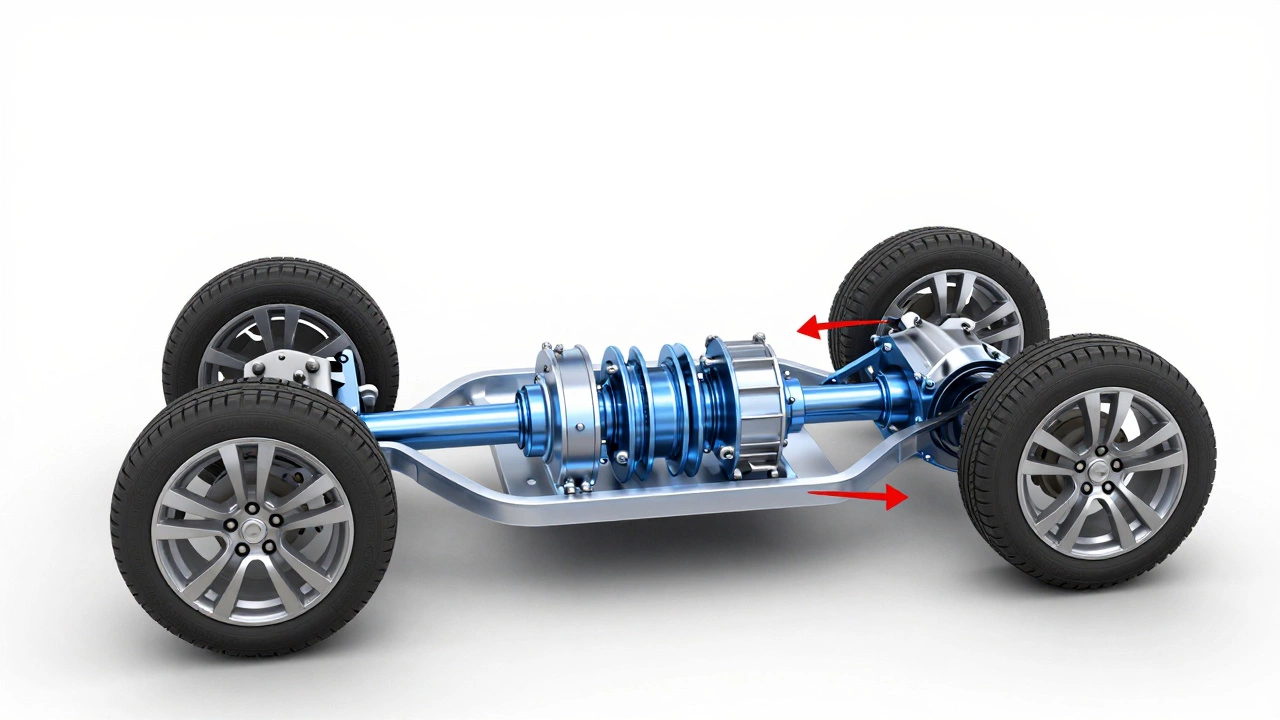
If you drive a car with All-Wheel Drive (AWD), you're playing a different game. In an AWD system, power is distributed to all four wheels, often via a complex Center Differential. This component is incredibly sensitive to the circumference of your tires. If you put two brand-new tires on the front and leave two worn ones on the back, those new tires will have a slightly larger diameter. This means they spin at a different speed than the old ones.
Why is that a problem? Your car's computer and mechanical gears think the wheels are slipping or moving at incorrect speeds. This puts constant, unnecessary stress on the differential. Over time, this can lead to a catastrophic failure of the drivetrain, which costs thousands to fix-far more than a set of four tires. Most manufacturers, like Subaru or Audi, explicitly recommend replacing all four to keep the rolling circumference identical across the entire vehicle. If you absolutely can't afford four, some shops might suggest "shaving" new tires to match the tread depth of the old ones, but that's a niche solution and not always practical.
Front-Wheel Drive and Rear-Wheel Drive Flexibility
For those driving Front-Wheel Drive (FWD) or Rear-Wheel Drive (RWD) vehicles, you have more breathing room. Since power isn't being split across both axles in the same way, a slight difference in tread depth won't destroy your transmission. However, you still have to deal with physics. If you replace 4 tires, you get a balanced "reset" of your car's grip. If you only replace two, you're creating a grip mismatch.
Think about your braking distance. If your front tires have massive grip but your rears are nearly smooth, the back end of the car is more likely to lose traction during a hard stop or a sharp turn. This can lead to fish-tailing, especially on wet roads. While it's technically possible to replace just two, you need to ensure the remaining tires are still well within the safe operating range. If your "good" tires only have 4mm of tread left, they'll be dead in another six months anyway. In that case, buying two now and two later is just paying for two separate installation and balancing appointments.
| Drivetrain Type | Recommended Action | Risk of Partial Replacement | Primary Concern |
|---|---|---|---|
| AWD | Replace all 4 | High | Differential Damage |
| FWD | 2 or 4 Tires | Low/Medium | Handling Imbalance |
| RWD | 2 or 4 Tires | Low/Medium | Traction Loss |
The Golden Rule of Tire Placement
Here is a point where many people get it wrong: where do the new tires go? If you only buy two, most people put them on the front because that's where the steering and power (in FWD cars) are. This is a mistake. You should always put the newest tires on the Rear Axle. This is a safety standard backed by tire manufacturers and safety organizations.
Why the rear? When you lose grip on the front tires (understeer), you can usually feel it and correct it by slowing down. But when you lose grip on the rear tires (oversteer), the back of the car swings out. This is much harder to control and often leads to a spin-out, especially in the rain. By putting the tires with the most Tread Depth on the back, you ensure the car stays stable and follows your line of travel during an emergency maneuver.
Understanding Tread Wear and the "Point of No Return"
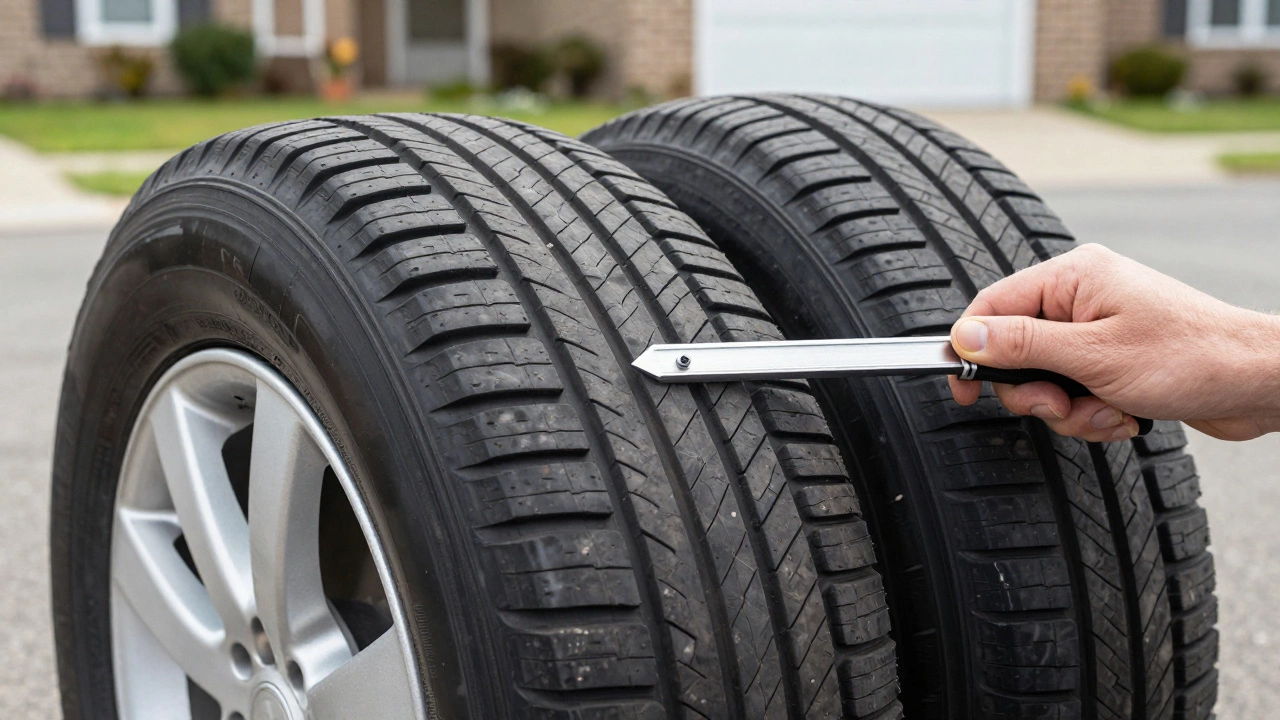
How do you know if the other two tires are actually "good enough" to keep? You can't just eyeball it. Use a tread depth gauge or the "penny test" (though in the UK, we look for the 1.6mm legal limit). If your remaining tires are below 3mm, they are effectively nearing the end of their useful life. At this stage, the grooves aren't deep enough to effectively channel water away, which increases the risk of Hydroplaning-where your car glides on a thin film of water instead of gripping the road.
Check for uneven wear patterns too. If you see "cupping" (dips in the tread) or "feathering" (edges worn at an angle), your tires are damaged regardless of how much tread is left. This usually points to an alignment issue. Replacing just two tires when you have a bad Wheel Alignment is like putting a band-aid on a broken leg; the new tires will be eaten away in a few thousand miles. Always get an alignment check when fitting new rubber to protect your investment.

Long-Term Value: Rotation and Matching
If you decide to go with a full set of four, you unlock the ability to perform a Tire Rotation. This is the process of moving tires from front to back (and sometimes side to side) every 5,000 to 8,000 miles. Because front tires usually wear faster due to steering and braking, rotating them evens out the wear across all four.
When you mix and match brands or models on the same car, you're mixing different rubber compounds and tread patterns. One brand might be designed for quietness and fuel efficiency, while another is built for high grip in the rain. Putting these on the same vehicle can lead to inconsistent handling. You might find the car pulls to one side or that the ABS (Anti-lock Braking System) triggers prematurely because the tires have different friction coefficients. For the smoothest ride, sticking to the same brand and model across all four wheels is the only way to guarantee the car behaves exactly as the engineers intended.
Can I mix different brands of tires on one car?
It is technically possible, but not recommended. Mixing brands often means mixing different tread patterns and rubber compounds. This can lead to uneven grip, unpredictable handling in the rain, and may even trigger your traction control system. For the best safety and performance, keep all four tires the same brand and model.
Is it legal to have different tread depths on different axles?
In most regions, including the UK, the law requires all tires to meet a minimum legal depth (1.6mm). As long as every tire is above that limit, it is legal. However, just because it is legal doesn't mean it's safe. A large difference in depth between the front and rear axles can compromise your car's stability during emergency braking.
How often should I rotate my tires?
A good rule of thumb is to rotate your tires every 5,000 to 8,000 miles. This ensures that the front tires (which wear faster) and the rear tires wear at a similar rate, extending the overall life of the set and keeping your handling consistent.
What happens if I only replace 2 tires on an AWD car?
On many All-Wheel Drive systems, replacing only two tires can cause the new tires to rotate at a different speed than the worn ones. This puts significant stress on the center differential, which can lead to expensive mechanical failure. Always check your owner's manual, but most AWD manufacturers insist on replacing all four.
Why do new tires go on the back?
New tires provide more grip. Placing them on the rear prevents oversteer (where the back of the car slides out), which is much harder for the average driver to control than understeer (where the front slides). It keeps the car more stable and predictable during sudden swerves or wet-weather braking.
Next Steps for Your Vehicle
If you're currently staring at your tires and feeling unsure, start by identifying your drivetrain. Look for "AWD," "4WD," "FWD," or "RWD" in your manual. If you have AWD, stop considering a 2-tire replacement and start shopping for a full set. If you have FWD or RWD, grab a tread depth gauge and check the "good" tires. If they have more than 4mm of tread and show no signs of cupping or cracking, you can likely get away with just two new tires on the rear axle.
Once the new tires are on, don't forget to ask the shop for a full wheel alignment. A new set of tires is a waste of money if your suspension geometry is pulling them into the ground at an angle. Finally, set a reminder in your calendar for 6,000 miles from now to get them rotated. Taking these small steps now prevents a massive repair bill later.