Exhaust Sizing Calculator
Engine Specifications
Recommended Pipe Diameter
Main Mid-Pipe Internal Diameter (ID)
Balanced scavenging effect.
Ready to Calculate
Enter your engine details to find the perfect exhaust fit.
There is a dangerous myth in the garage world that bigger is always better. You see it all the time: someone with a modest 200-horsepower engine slaps on massive 3-inch pipes, expecting more power, only to find their car feels sluggish at low RPMs and costs a fortune in noise complaints. If you are trying to figure out what size exhaust for 200 hp is right for your build, the answer isn't just about picking the largest number on the shelf. It is about matching the flow of gas leaving your engine to the amount of air entering it.
Getting this wrong doesn't just kill performance; it can actually reduce horsepower compared to your stock setup. A 200-hp engine sits in a tricky middle ground. It has enough power to benefit from reduced restriction, but not enough airflow to fill large-diameter pipes effectively. Let's break down exactly how to calculate the right fit so you don't waste money or torque.
The Physics of Flow: Why Diameter Matters
To understand why a specific size works, you have to look at gas velocity. When an engine fires, it pushes exhaust gases out. These gases need to move fast enough to create a vacuum effect (scavenging) that pulls fresh fuel-air mixture into the cylinders for the next cycle. If the pipe is too narrow, the gas gets backed up (backpressure), choking the engine. If the pipe is too wide, the gas moves too slowly, losing momentum and failing to pull efficiently.
Think of it like water flowing through a hose. A garden hose (small diameter) creates high pressure if you restrict the end, but a fire hydrant hose (large diameter) requires a massive volume of water to keep the same speed. Your 200-hp engine is closer to the garden hose than the fire hydrant. It needs a balance where the gas travels at an optimal velocity-usually between 150 and 200 feet per second-to maximize scavenging efficiency.
Does a larger exhaust always increase horsepower?
No. On lower horsepower engines like a 200 hp build, an excessively large exhaust can reduce low-end torque and throttle response because the exhaust gas velocity drops too low to create effective scavenging.
Recommended Sizes for 200 Horsepower Engines
For most naturally aspirated engines producing around 200 horsepower, the sweet spot for the main exhaust piping is typically between 2.0 inches and 2.25 inches. This range allows sufficient flow without sacrificing the low-RPM torque that makes a daily driver fun to use. If you go larger than 2.5 inches, you will likely notice a "flat spot" in the power band where the engine feels unresponsive below 3,000 RPM.
However, the type of engine changes the equation slightly. A four-cylinder engine usually benefits from tighter packaging, so 2.0-inch primaries merging into a 2.25-inch mid-pipe is often ideal. For a six-cylinder or V8 making 200 hp (which is quite mild for those platforms), you might get away with 2.25-inch to 2.5-inch piping because the individual cylinder pulses are less frequent, requiring slightly larger volumes to clear.
| Engine Configuration | Primary/Header Tubes | Mid-Pipe/Main Run | Muffler Inlet | Expected Result |
|---|---|---|---|---|
| 4-Cylinder (Turbo/N/A) | 1.5" - 1.75" | 2.0" - 2.25" | 2.25" - 2.5" | Balanced torque and top-end flow |
| 6-Cylinder (Inline) | 1.75" - 2.0" | 2.25" - 2.5" | 2.5" - 2.75" | Smooth power delivery |
| V8 (Small Block) | 1.75" - 2.0" | 2.5" | 2.75" - 3.0" | Best for high-RPM operation |
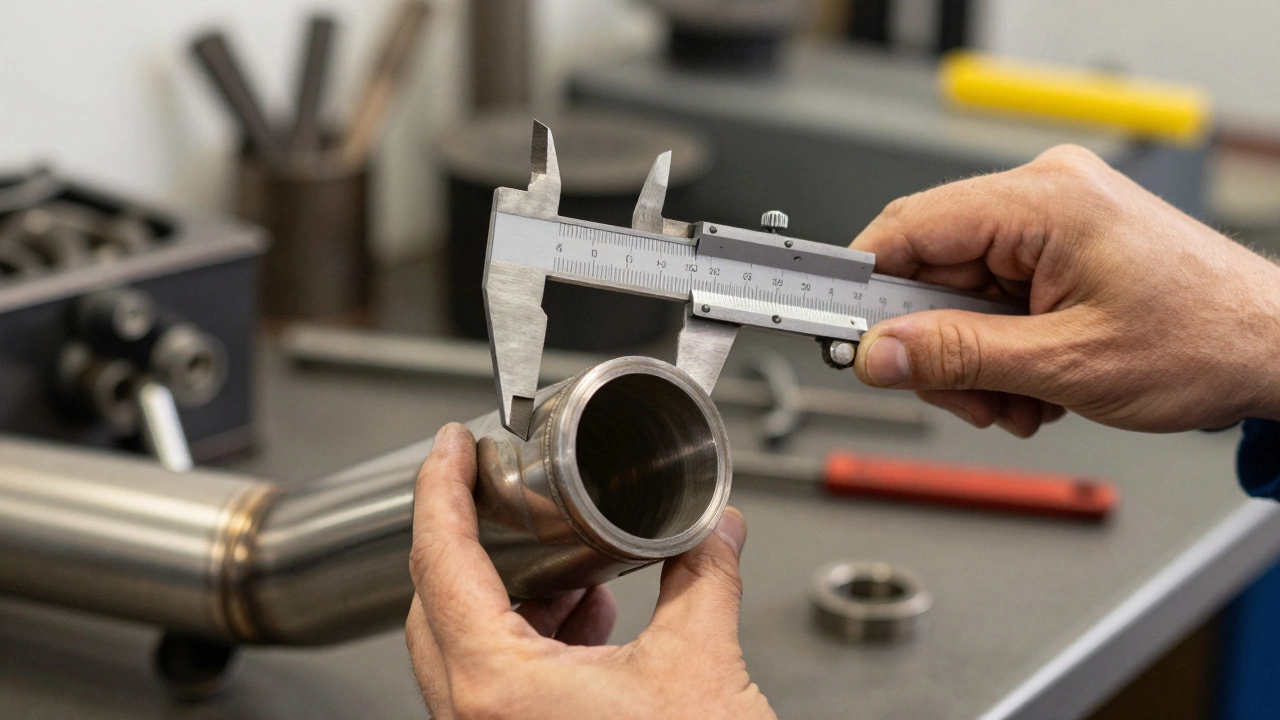
Note that these numbers refer to the internal diameter (ID). Many manufacturers advertise the outer diameter (OD), which can be misleading. A 2.5-inch OD pipe with thick walls might only have a 2.25-inch ID. Always check the specs for internal diameter when comparing parts.
The Role of Turbos and Forced Induction
If your 200-horsepower engine is turbocharged, the rules shift dramatically. Turbochargers rely on exhaust gas energy to spin the turbine wheel. You want the exhaust gases moving as fast as possible to hit the turbine blades quickly. This means smaller diameters upstream of the turbo are often preferred.
For a turbo setup making 200 hp (which is very low boost), you generally want to keep the pre-turbo piping tight-often 1.5-inch to 1.75-inch-and then step up immediately after the turbo outlet. The post-turbo section can handle 2.5-inch to 3-inch piping because the turbo compresses the air, creating higher volume downstream. However, even here, going over 3 inches is usually unnecessary unless you plan to significantly increase boost levels later.
Turbocharger is a device that uses exhaust gas energy to compress intake air, increasing engine power density. In a 200 hp application, proper sizing ensures quick spool-up times without excessive lag.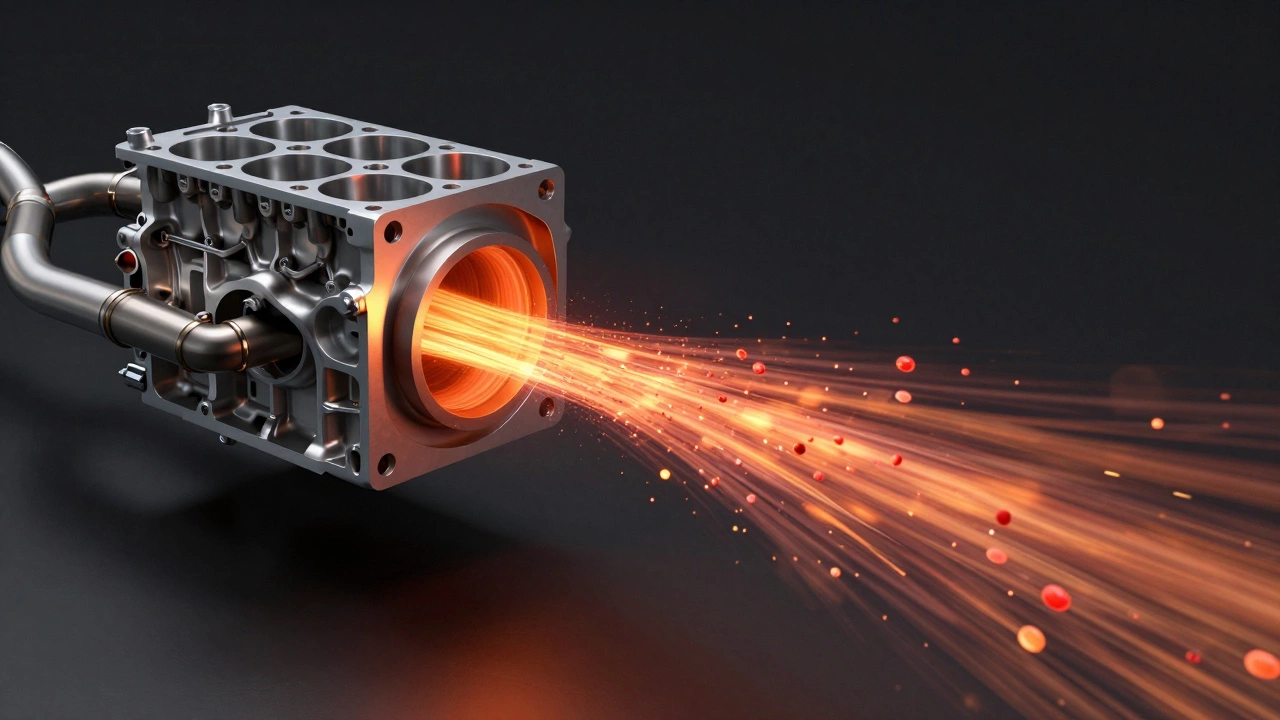
Backpressure vs. Restriction: Clearing the Confusion
You will hear the term "backpressure" used incorrectly all the time. True backpressure is necessary for valve timing stability and scavenging. What you actually want to avoid is "restriction." Restriction occurs when the exhaust cannot exit fast enough, causing pressure to build up inside the combustion chamber after the exhaust valve opens. This forces the engine to work harder to push out old gases, wasting energy.
A well-designed 2.25-inch system for a 200-hp car will have minimal restriction while maintaining healthy backpressure characteristics. You can test this simply: if your car accelerates smoothly from idle to highway speeds without hunting for gears or feeling weak, your restriction is low. If it feels flat until 4,000 RPM, you might be restricted. If it feels hollow and lacks punch under 3,000 RPM, you are likely over-sized.
Mufflers and Tips: The Final Touch
The main pipe diameter sets the foundation, but the muffler and tips play a role in fine-tuning performance and sound. The muffler inlet should match or be slightly larger than the main pipe to prevent a bottleneck. If you run a 2.25-inch pipe, do not feed it into a 2.0-inch muffler inlet. That creates an immediate restriction point.
For tips, aesthetics often drive the choice, but functionality matters. Tips should not be narrower than the tailpipe they attach to. A common mistake is buying flashy 4-inch chrome tips that choke off a 2.5-inch pipe. Ensure the tip's internal diameter matches the exhaust outlet. Also, consider the material. Stainless steel (304 or 409 grade) resists corrosion better than aluminized steel, which is crucial since exhaust systems face extreme heat cycles and road salt, especially in places like Manchester where winters are damp.

Installation and Fitment Considerations
When installing a new exhaust, alignment is critical. Exhaust systems expand when hot. If you bolt everything down tightly while cold, the metal expansion can crack welds or bend pipes. Leave a small amount of slack in hangers and ensure clamps are snug but not overtightened. Use high-quality exhaust paste on flanges to seal leaks; even a small leak near the oxygen sensor can confuse your engine computer, leading to poor fuel economy and rough idling.
Also, check local noise regulations. In the UK, strict laws govern vehicle noise emissions. A straight-pipe or overly aggressive muffler might give you that aggressive rumble, but it could fail your MOT (Ministry of Transport) test. Aim for a sporty tone rather than a deafening roar. High-flow catalytic converters are also a consideration; removing the cat entirely is illegal in many jurisdictions and harms the environment, while a high-flow unit maintains compliance while reducing restriction.
Cost vs. Benefit Analysis
Upgrading your exhaust is one of the cost-effective modifications you can make, but diminishing returns set in quickly. A quality aftermarket cat-back system for a 200-hp car might cost between £300 and £600. You might gain 5-10 horsepower, mostly due to improved breathing and reduced weight. The real benefit is often the sound and the confidence in driving, rather than raw speed. If you are chasing significant power gains, focus on intake, tuning, or forced induction first. The exhaust should support those upgrades, not lead them.
Can I mix different pipe sizes in one exhaust system?
Yes, this is called a stepped exhaust. It is common to start with smaller headers (1.75") and step up to a larger mid-pipe (2.25") and finally a larger muffler inlet (2.5"). This helps maintain gas velocity early in the system while allowing volume to expand later.
How much horsepower does a new exhaust add to a 200 hp car?
Typically 3-8 horsepower on a naturally aspirated engine, provided the stock system was restrictive. Most gains come from improved throttle response and sound rather than peak power numbers.
Is 2.5 inch exhaust too big for 200 hp?
It depends on the engine. For a 4-cylinder, 2.5" is likely too big and will hurt low-end torque. For a V8, 2.5" is acceptable, especially if the car is driven at higher RPMs frequently.
Does exhaust size affect fuel economy?
Slightly. A properly sized exhaust reduces engine load, which can improve MPG by 1-2%. However, drivers with louder exhausts often tend to rev higher, which negates any fuel savings.
What is the difference between OD and ID in exhaust pipes?
OD is Outer Diameter, ID is Inner Diameter. Performance depends on ID because that is where the gas flows. A 2.5" OD pipe with thick walls may have only a 2.25" ID. Always buy based on ID specifications.