Spark Plug Diagnosis Tool
This diagnostic tool helps you determine if your car's symptoms are likely caused by bad spark plugs. Enter your symptoms and vehicle information below to get personalized recommendations.
Symptoms Check
Select all symptoms you're experiencing:
Vehicle Information
If your car sputters, hesitates, or won’t start on a cold morning, it’s not always the battery. More often than not, it’s your spark plugs. These small components do the heavy lifting-igniting the fuel-air mix in your engine’s cylinders. When they fail, your engine doesn’t just lose power. It starts acting up in ways that feel like a mystery. The good news? Testing for bad spark plugs doesn’t need a garage or fancy tools. You can do it yourself in under 30 minutes.
What Happens When Spark Plugs Go Bad?
Spark plugs create the tiny electric spark that sets off combustion in your engine. Over time, they wear out. Carbon builds up. The gap between the electrodes widens. The ceramic insulator cracks. When that happens, the spark becomes weak or skips entirely. That’s when your engine starts misfiring.
Modern cars have onboard diagnostics, but they don’t always catch spark plug issues early. You’ll feel it before the check engine light comes on. A misfire might feel like a stumble when you press the gas. Or your car might idle roughly, like it’s breathing unevenly. In cold weather, it might take three tries to turn over. These aren’t just annoyances-they’re signs your spark plugs are failing.
Common Signs of Bad Spark Plugs
- Engine misfires-You’ll hear a popping or backfiring sound, especially under acceleration.
- Hard starting-The engine turns over but won’t catch, especially after sitting overnight.
- Reduced fuel economy-You’re filling up more often, even if your driving habits haven’t changed.
- Slow acceleration-The car feels sluggish when you step on the gas, like it’s dragging.
- Unstable idle-The engine shakes or vibrates when stopped at a light.
- Check engine light-Codes like P0300 (random misfire) or P0301-P0308 (cylinder-specific misfires) often point to spark plug issues.
These symptoms can overlap with other problems-like a clogged fuel injector or bad coil-but spark plugs are the most common cause. If your car is over 40,000 miles and you’ve never replaced them, it’s time to check.
How to Test Spark Plugs Without Removing Them
You don’t need to pull the plugs right away. Start with a quick visual and performance check.
- Listen to the engine at idle. Turn the car on and let it run. Put your hand near the engine (but not on hot parts). Feel for uneven vibrations. A healthy engine runs smooth. A bad plug causes a rhythmic shake.
- Use a scan tool. If you have an OBD2 scanner (even a cheap one from Amazon), plug it in. Look for misfire codes. If cylinder 3 keeps showing P0303, that’s your problem plug.
- Check the ignition coils. Sometimes the coil is the issue, not the plug. Swap the coil from cylinder 1 to cylinder 2. If the misfire moves, it’s the coil. If it stays on cylinder 1, the plug is likely bad.
This method works best on cars with coil-on-plug (COP) systems-most cars made after 2010. Older cars with spark plug wires need a different approach.

How to Remove and Inspect Spark Plugs
If the quick checks point to bad plugs, it’s time to pull them. Here’s how:
- Turn off the engine and let it cool. Spark plugs sit in hot metal. Working on them while hot can crack the cylinder head.
- Remove the ignition coil or spark plug wire. For COP systems, unplug the electrical connector and unscrew the coil with a socket. For older cars, gently twist and pull the wire off the plug.
- Use a spark plug socket. A 5/8-inch socket with a rubber insert works best. It grips the plug without crushing it.
- Unscrew the plug slowly. Use a ratchet. Don’t force it. If it’s stuck, spray a little penetrating oil around the base and wait 10 minutes.
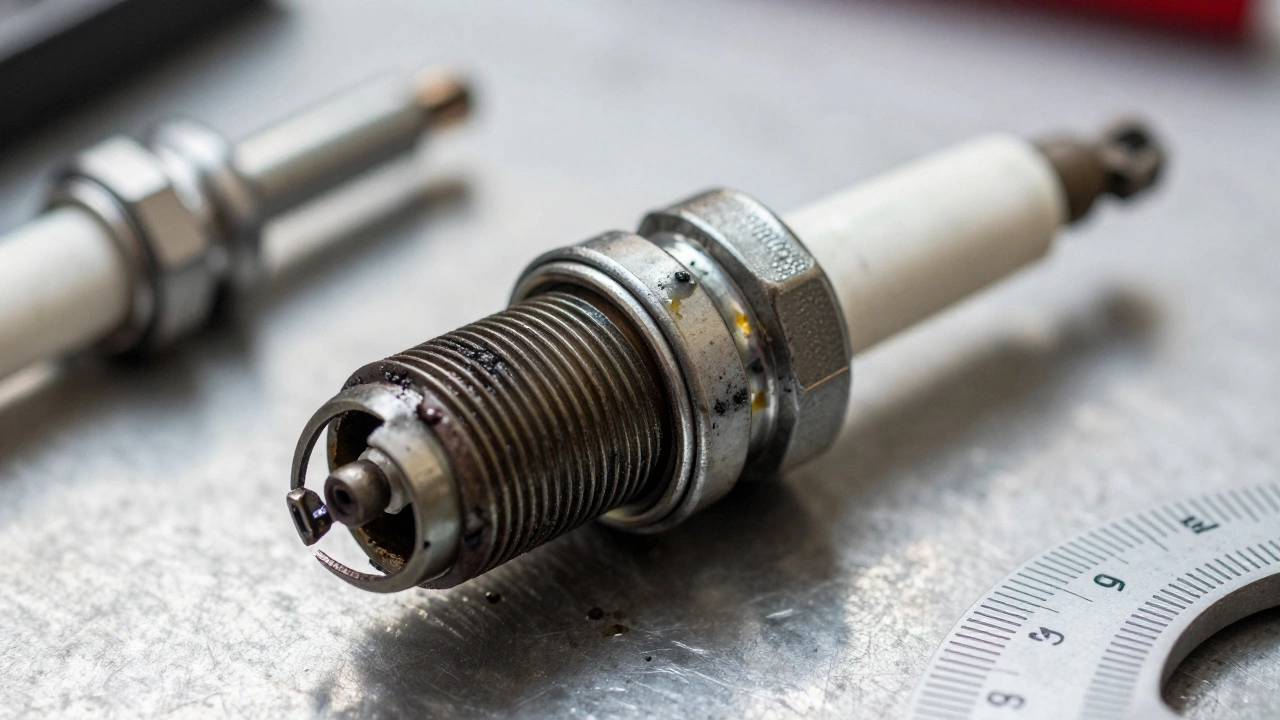
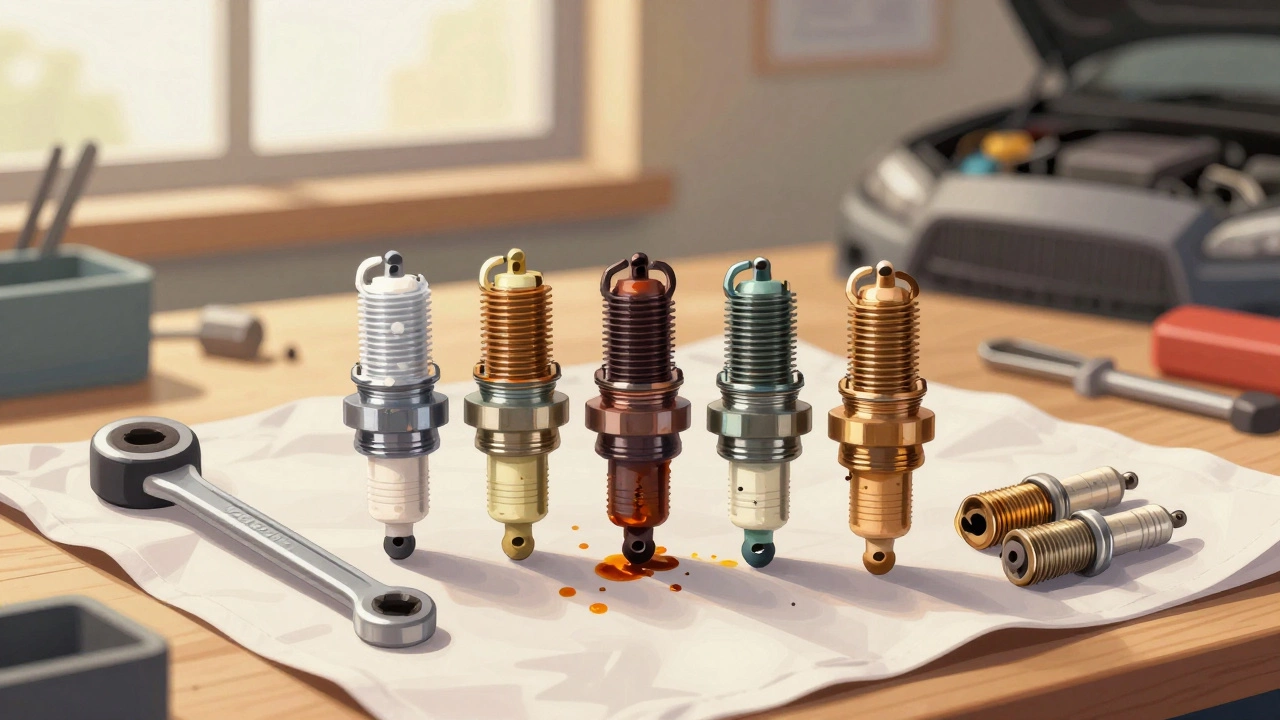
- Inspect the plug. Look at the electrode and ceramic tip. Here’s what to look for:
- Black, sooty deposits-Sign of rich fuel mixture or long-term neglect.
- White or blistered ceramic-Overheating. Could mean wrong heat range or engine running too hot.
- Oil residue-Oil is leaking into the combustion chamber. This means worn valve seals or piston rings.
- Worn or melted electrodes-The gap is too wide or the metal has eroded. This is the classic sign of age.
- Broken ceramic-The plug is dead. Replace it immediately.
Normal spark plugs have a light tan or grayish color on the electrode. That’s a healthy burn. Anything darker, lighter, or damaged needs replacement.
How to Check Spark Plug Gap
Even if the plug looks okay, the gap might be wrong. The gap is the space between the center electrode and the ground electrode. Too wide? The spark can’t jump. Too narrow? The spark is weak.
Use a feeler gauge-those thin metal strips with labeled thicknesses. Most spark plugs need a gap between 0.028 and 0.060 inches. Check your owner’s manual for the exact spec.
Slide the correct thickness between the electrodes. If it fits snugly, the gap is good. If it slides through easily, the gap is too wide. If it won’t fit at all, it’s too narrow. You can gently bend the ground electrode with a gap tool to adjust it-but only if the plug isn’t worn out.
Pro tip: Never adjust a plug with heavy deposits or worn electrodes. Replace it instead.
When to Replace Spark Plugs
Most manufacturers recommend replacing spark plugs every 30,000 to 100,000 miles. But that’s just a guideline. Real-world conditions matter more.
- If you drive short trips often (under 5 miles), carbon builds up faster. Replace every 30,000 miles.
- If you use low-quality fuel, plugs foul quicker.
- If your car has over 80,000 miles and you’ve never changed the plugs, replace them now-even if they seem fine.
- Platinum and iridium plugs last longer but still wear out. They’re not forever.
Don’t wait for a breakdown. Spark plugs are cheap. A misfire can damage your catalytic converter-and that repair costs 10 times more.
What to Look for When Buying New Spark Plugs
Not all spark plugs are the same. Using the wrong type can hurt performance or even damage your engine.
- Match the part number. Use your VIN or engine code to find the exact replacement. Your manual or an auto parts store can help.
- Heat range matters. A plug that’s too hot can cause pre-ignition. Too cold, and it fouls. Stick to the manufacturer’s spec.
- Electrode material. Copper is standard and affordable. Platinum lasts longer. Iridium is the most durable and offers the best performance.
- Gap setting. Some plugs come pre-gapped. Check anyway. Don’t assume.
Brands like NGK, Denso, and Bosch are reliable. Avoid no-name brands from discount stores. You’re not saving money-you’re risking engine damage.
What Not to Do
- Don’t overtighten. Spark plugs are threaded into aluminum. Tighten to the torque spec (usually 15-20 lb-ft). If you don’t have a torque wrench, snug them until the washer contacts the seat, then give it a quarter-turn more. Over-tightening cracks the threads.
- Don’t reuse old plugs. Even if they look okay, the gap is likely wrong and the metal is fatigued.
- Don’t ignore oil leaks. If you see oil on the plug, fix the root cause. Otherwise, the new plug will foul again in weeks.
- Don’t mix brands or types. Use the same plug in all cylinders. Mixing can cause uneven firing.
Final Check After Replacement
Once you’ve installed new plugs:
- Reconnect all coils and wires securely.
- Start the engine. Listen for smooth idle.
- Take it for a short drive. Accelerate gently. Does it respond smoothly?
- Clear any misfire codes with your scanner.
If the car runs better, you fixed it. If not, you might have another issue-like a bad coil, fuel injector, or vacuum leak. But 9 times out of 10, bad spark plugs were the culprit.
Replacing spark plugs is one of the easiest, cheapest maintenance tasks you can do. It’s not glamorous, but it keeps your car running like it should. And in the UK’s damp, cold winters, a reliable start matters more than you think.
How often should I replace spark plugs?
Most manufacturers recommend replacing spark plugs every 30,000 to 100,000 miles, depending on the type. Copper plugs last around 30,000 miles, platinum around 60,000, and iridium up to 100,000. But if you drive mostly short trips, stop-and-go traffic, or use low-quality fuel, replace them every 30,000 miles regardless of the type.
Can bad spark plugs cause the check engine light to come on?
Yes. A misfire caused by bad spark plugs triggers codes like P0300 (random misfire) or P0301-P0308 (specific cylinder misfire). The check engine light will turn on, often flashing if the misfire is severe. This is one of the most common reasons for the light to appear.
Do I need to replace all spark plugs at once?
Yes. Even if only one plug is bad, the others are likely close to failing. Replacing them all ensures even performance, consistent ignition, and prevents future misfires. Mixing old and new plugs can cause uneven firing and reduce engine efficiency.
Can I clean and reuse old spark plugs?
It’s not recommended. You can clean off carbon deposits with a wire brush or spark plug cleaner, but you can’t restore worn electrodes or fix cracked ceramic. Even a cleaned plug will have a wider gap and weaker spark. The risk of failure is too high. New plugs cost less than a tank of fuel.
Why does my car misfire only when it’s cold?
Cold weather makes fuel harder to vaporize. If your spark plugs are worn, the spark isn’t strong enough to ignite the mixture reliably when it’s cold. Once the engine warms up, fuel vaporizes easier, so the misfire disappears. This is a classic sign of aging spark plugs.
What happens if I don’t replace bad spark plugs?
Ignoring bad spark plugs leads to poor fuel economy, rough running, and loss of power. Over time, unburned fuel can flood your catalytic converter, causing it to overheat and fail. Replacing a catalytic converter costs £800-£1,500. Spark plugs cost £20-£80. The choice is clear.
Testing for bad spark plugs doesn’t require a mechanic. With a little time and the right tools, you can diagnose and fix the issue yourself. It’s one of the most cost-effective repairs you can make-and it makes your car feel like new again.